
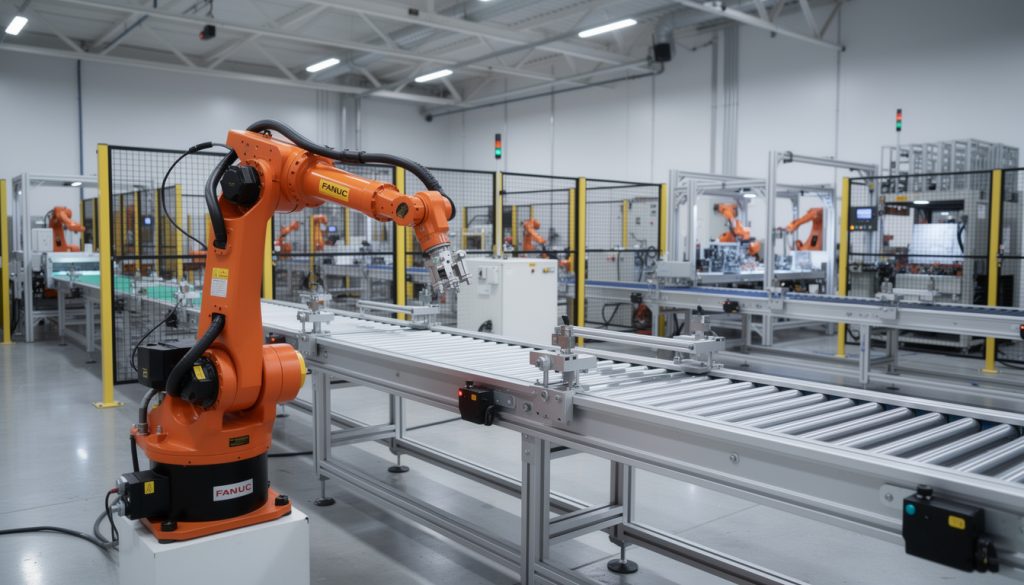
What are Fanuc Solutions in industrial automation?
Fanuc Solutions refers to packaged and custom automation approaches that combine industrial robots, controllers, software, and integration services to automate manufacturing tasks such as handling, welding, palletizing, and inspection. These solutions typically include a robotic arm, end-of-arm tooling, safety systems, and programming aligned to a specific process. In practice, Fanuc Solutions can mean anything from a single robot cell to multi-station lines with vision, conveyors, and quality checks. Buyers evaluating solutions usually compare feasibility, throughput impact, floor space, safety, and total cost of ownership. Here is a detailed breakdown:
What solution scope usually includes
Typical Fanuc Solutions include the robot, controller, End-of-Arm Tooling (EOAT), guarding, safety Programmable Logic Controller (PLC), sensors, fixtures, and commissioning services. The robotic arm serves as the centerpiece, but the surrounding components determine whether the cell meets production requirements. Controllers handle motion control and I/O management, while EOAT provides the interface between robot and workpiece. Safety PLCs monitor interlocks and emergency stops, ensuring compliance with applicable standards.
What is often excluded unless specified
Common exclusions from standard Fanuc Solutions include upstream and downstream conveyors, part presentation solutions, utilities like compressed air and power distribution, building modifications, networking infrastructure, and operator staffing. These items often represent significant additional costs and project complexity. Buyers should clarify scope boundaries early to avoid budget surprises during implementation.
What is a Fanuc integrator?
A Fanuc integrator is a systems integration partner that designs, builds, programs, and commissions robotic workcells and automation systems using Fanuc robots and related tooling. Integrator responsibilities often include process definition, mechanical and electrical design, risk assessment, safety validation, Fanuc robot programming, and operator training. Commercial buyers typically rely on Fanuc integrators to translate a manufacturing requirement into an engineered cell with documented performance targets and acceptance testing. Official sources like Fanuc America outline the role of an authorized integrator in the automation ecosystem.
The Fanuc integrator serves as the bridge between manufacturing needs and technical implementation. They assess production requirements, select appropriate Fanuc robot models, design mechanical interfaces, and develop control logic. Most integrators maintain certification with Fanuc, ensuring they stay current with product capabilities and programming methods. This certification provides buyers with confidence in technical competency and ongoing support availability.
How does a robotic arm solution differ from buying an industrial robot only?
Buying an industrial robot provides the core robot hardware, while a Fanuc robotic arm solution includes the engineered cell around it—tooling, safety, fixtures, programming, and validation needed to run production. Many first-time automation projects fail to meet expectations because the robot is not the bottleneck; part presentation, tooling wear, changeover time, and safety constraints often determine throughput. A solution approach defines interfaces and responsibilities early, reducing commissioning risk and change orders.
The difference becomes apparent during implementation. A standalone Fanuc robotic arm requires buyers to source complementary components separately, manage multiple suppliers, and integrate systems themselves. Solutions provide a single point of responsibility for performance and troubleshooting. This approach typically reduces project risk but may increase upfront costs compared to self-integration approaches.
Typical add-ons that determine success
Critical components in Fanuc Solutions include EOAT, sensors, vision systems, quick-change tooling, part nests, and error-proofing mechanisms. EOAT design directly affects cycle time and part handling reliability. Vision systems enable flexible part handling and quality inspection. Quick-change tooling reduces changeover time for multi-product applications. Error-proofing mechanisms prevent damage from incorrect part placement or orientation.
Documentation and handover deliverables
Essential documents include as-built drawings, I/O lists, program backups, notes on program structure, and a maintenance plan. As-built drawings reflect final installation details and modifications made during commissioning. I/O lists document signal connections and addresses for troubleshooting. Program backups ensure recovery capability if controllers fail. Maintenance plans specify lubrication schedules, wear part replacement intervals, and recommended spare parts inventory.
Which applications are the best fit for Fanuc robot solutions?
The best-fit applications are repetitive, measurable tasks with stable part flow—commonly machine tending, palletizing, material handling, welding, and basic inspection. High ROI use cases usually have clear labor displacement or throughput gains and limited variability. If parts vary widely, Fanuc Solutions often require flexible tooling, vision guidance, or standardized fixtures. A feasibility review typically checks cycle time, uptime targets, changeover frequency, and quality requirements.
Machine tending
Machine tending represents an ideal application for Fanuc robot solutions due to predictable interfaces, measurable cycle time, and strong value in improving uptime. Fanuc itself provides examples of machine tending robots that handle loading, unloading, and secondary operations. The structured environment around CNC machines, lathes, and stamping presses creates favorable conditions for robotic automation with clear return on investment.
Palletizing and depalletizing
Palletizing suits Fanuc Solutions because of consistent patterns, clear safety zoning, and fast payback. Robot payloads match typical case and bag weights, while reach envelopes cover standard pallet dimensions. Pattern programming handles most SKU variations without complex vision requirements. Safety design is straightforward with defined robot work zones and human access areas.
Welding and joining
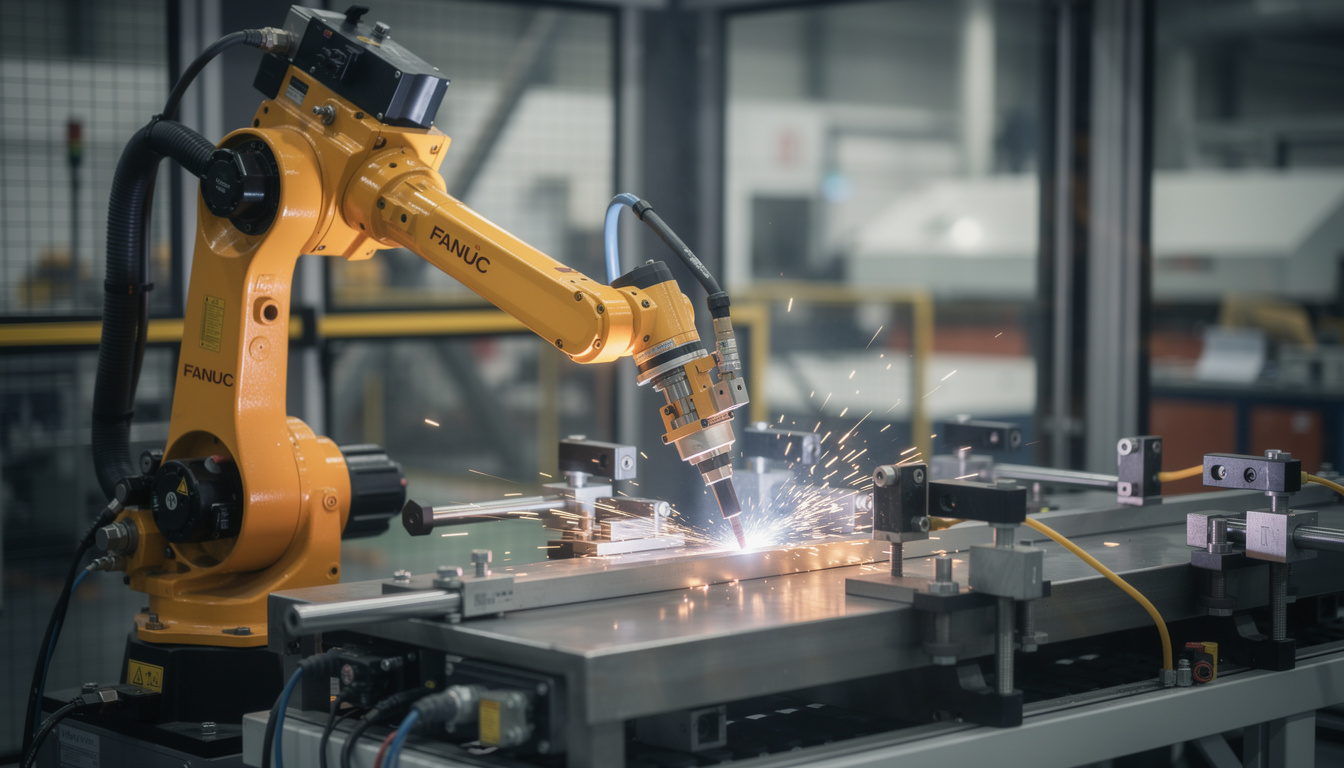
Robotic welding delivers repeatability, quality consistency, and improvements in fume exposure and safety. Fanuc robots handle arc welding, spot welding, and specialized joining processes. Path accuracy and speed control directly impact weld quality and cycle time. Integration with welding power sources and wire feeders requires coordination but follows established practices across the industry.
How do companies choose the right payload and reach for a Fanuc robotic arm?
Companies select payload and reach based on the heaviest tool-and-part load, required working envelope, wrist moments and inertia, and the speed needed to hit cycle time. Payload is not just the part weight; it includes grippers, brackets, hoses, and safety margin. Reach must cover pick and place positions without singularities or awkward wrist angles. Many projects also need to account for future tooling upgrades, which can increase mass and inertia.
The Fanuc robotic arm selection process starts with mapping the required work envelope and identifying the heaviest load condition. Engineers calculate total payload including EOAT, pneumatic cylinders, cables, and a safety factor typically ranging from 10-20%. Speed requirements determine whether a larger robot is needed to maintain cycle time at higher payloads. Wrist moment specifications become important for long or offset tooling configurations.
Common sizing mistakes to avoid
Frequent sizing errors include undersizing wrist moments, ignoring cable dress-out weight, and assuming payload directly translates to safe operation at full speed. Wrist moments matter more than payload for extended tooling. Cable management systems add weight that affects dynamic performance. Fanuc robots may require speed reduction at maximum payload to maintain path accuracy and prevent mechanical stress.
What does a typical Fanuc robot integration project timeline look like?
A typical integration runs from initial feasibility through design, build, programming, and commissioning, often spanning several weeks to several months depending on complexity and plant readiness. Timelines are driven by tooling lead times, safety approvals, and how quickly parts and process data are available. A practical plan also includes time for operator training, run-at-rate testing, and a stabilization period after go-live.
Phases and deliverables
Key phases follow this sequence: Feasibility → concept → detailed design → build → Factory Acceptance Test (FAT) → site installation → Site Acceptance Test (SAT) → ramp-up. Feasibility studies assess technical viability and ROI projections. Concept design establishes layout and major components. Detailed design produces fabrication drawings and bill of materials. For complex automation initiatives, companies often seek specialized expertise to navigate these phases successfully.
What causes schedule slips
Common delays include late part samples, unclear acceptance criteria, facility constraints, and change requests. Part samples enable tooling design and testing, but production delays often postpone delivery. Acceptance criteria disputes arise when performance expectations differ between buyer and Fanuc integrator. Facility constraints like inadequate power, compressed air, or floor space require resolution before installation. Change requests during build phases can significantly impact schedules and budgets.
What is included in Fanuc robot programming for a production cell?
Production programming typically includes motion paths, I/O logic, fault handling, recovery routines, cycle optimization, and integration with peripherals such as vision, conveyors, and safety systems. Commercial buyers should expect more than basic robot movement. Robust Fanuc robot programming includes alarms with clear messages, safe restart logic, manual modes for maintenance, and structured code that can be supported long-term. Program maintainability often matters as much as cycle time for sustained operations.
What good recovery looks like
Effective recovery strategies include safe stop states, part-present checks, homing strategy, and clear operator prompts. Safe stops position the robot away from interference zones and release pneumatic grippers safely. Part-present sensors verify successful picks and placements before continuing. Understanding these advanced aspects of robot control is one of the First Skills needed in robotics applications. Homing routines establish known positions after power loss or emergency stops.
How programming ties to OEE
Shorter recovery times and fewer nuisance faults improve Overall Equipment Effectiveness more significantly than marginal speed gains. Well-designed Fanuc robot programming minimizes downtime through predictive fault detection and simplified troubleshooting procedures. Operators can resolve most issues without calling maintenance or engineering support. This approach maximizes productive time and reduces labor costs associated with robot cell support.
What safety requirements apply to industrial robot cells?
Industrial robot cells require a documented risk assessment and safety measures such as guarding, interlocks, emergency stops, and safe operating procedures aligned to applicable safety standards and local regulations. Safety design affects layout, throughput, and maintenance access. A well-designed cell balances protection with usability through safe access points, clear lockout steps, and predictable restart behavior. Adherence to standards, such as those recommended by OSHA, remains critical for compliance and worker protection. Buyers should require safety documentation, validation evidence, and training for operators and maintenance staff.
Safety deliverables to request
Key safety documents include risk assessment, safety circuit description, validation records, and signage procedures. Risk assessments identify hazards and document mitigation measures. Safety circuit descriptions explain interlock logic and emergency stop functions. Validation records demonstrate that safety systems perform as intended under fault conditions. Signage and procedures guide operators through safe operation and maintenance activities.
What training is needed for Fanuc robot solutions?
Training requirements cover operators, maintenance technicians, and programmers across basic operation, fault recovery, preventive maintenance, and advanced programming capabilities. Operator training focuses on normal production activities, changeover procedures, and first-level troubleshooting. Maintenance training addresses mechanical systems, pneumatics, electrical connections, and routine service tasks. Programmer training covers Fanuc robot programming languages, motion optimization, and system integration techniques.
Hands-on training proves more effective than classroom instruction for sustaining Fanuc Solutions operations. Training should occur on the actual production cell rather than generic equipment. Ongoing skill development through refresher courses and advanced modules helps maximize the value of automation investments. Many Fanuc integrators provide training as part of project delivery, with additional courses available through manufacturer training centers.
| Training Type | Target Audience | Duration | Key Topics |
|---|---|---|---|
| Basic Operation | Production Operators | 1-2 days | Start/stop procedures, changeovers, basic troubleshooting |
| Maintenance | Technicians | 3-5 days | Preventive maintenance, mechanical systems, diagnostics |
| Programming | Engineers | 5-10 days | Motion programming, I/O configuration, system integration |
| Safety | All Personnel | 1 day | Lockout procedures, emergency response, safety systems |
Assatec Robotics was founded in 1997 and specializes in developing custom robotic cells and automation systems. The company serves as a leading Fanuc systems integrator.
How long does it take to see ROI from Fanuc robot solutions?
ROI timelines typically range from 12 to 36 months depending on labor costs, throughput gains, and solution complexity. Machine tending applications often deliver faster payback than complex assembly operations. Factors include equipment utilization, maintenance costs, and productivity improvements beyond direct labor displacement.
Can existing production lines be retrofitted with Fanuc robots?
Most production lines can accommodate robotic integration with appropriate planning and modification. Retrofit projects require assessment of available space, utilities, safety zones, and integration points. Existing conveyors and machines may need upgrades to interface properly with robotic systems.
What maintenance is required for Fanuc robot solutions?
Regular maintenance includes lubrication of robot joints, replacement of wear parts like cables and pneumatic seals, calibration checks, and software backups. Preventive maintenance schedules depend on operating hours and environmental conditions. Most industrial robots require major overhaul every 5-7 years of continuous operation.
How do Fanuc robot solutions handle product changeovers?
Changeover capability depends on tooling design and programming flexibility. Quick-change tooling systems enable fast transitions between products. Vision systems and flexible programming allow robots to handle multiple part types without physical changes. Changeover times range from minutes to hours depending on complexity.
click here for more info: https://assatec.co.il/